

A benchmark study led by Arcep, CGE, Arcom, and ANCT
Launched in 2000, this study aims to:
- to measure the adoption of equipment by French people and study digital practices;
- detect inequalities in access and skills, whether voluntary or involuntary;
- to enable public authorities to anticipate major trends and implement policies that promote digital inclusion for all.
In 2025, The survey was conducted from June 5 to 21, 2025, among 4,145 people residing in metropolitan France, divided into three distinct target populations (12 to 17 years old, 18 years and older, 18 years and older who are digitally excluded), with adapted questionnaires and specific quotas, and using two types of data collection:
- 3,343 people aged 18 and over were surveyed online in the Living Conditions and Aspirations (CDV) survey, with quotas for age, gender, socio-professional classification (PCS), level of education, size of urban area, region, and type of housing.
- 601 people aged 18 and over who are digitally excluded (i.e., who do not have a fixed internet connection at home) were interviewed by telephone, with quotas based on data from the 2024 INSEE survey on information and communication technologies (ICT) (gender, age, socio-professional category, region, size of urban area).
- 201 individuals aged 12 to 17 were surveyed online, after obtaining prior consent from a parent, with the following quotas: age, gender, region, size of urban area, and socioeconomic status of the reference person.
Open data
All survey data since 2007 is available as open data on the data.gouv.fr website.
Documents from the 2025 Digital Barometer
PDF document
PDF document
PDF document
Digital inclusion issues in the daily lives of French people
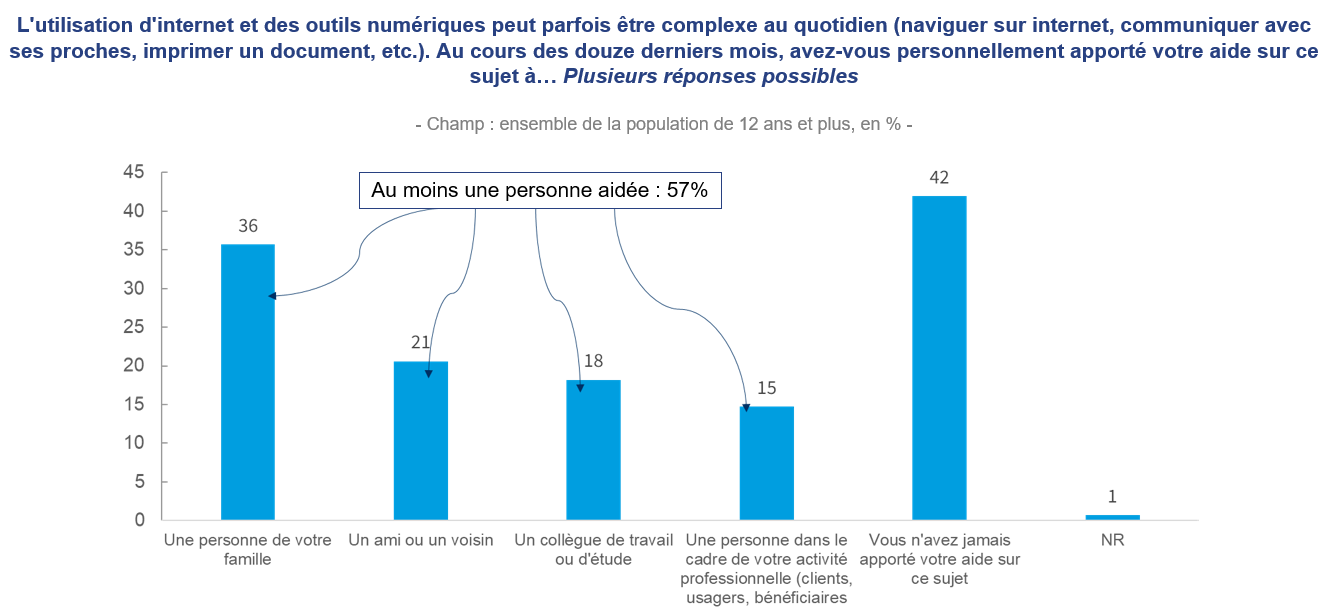
Digital inclusion in the daily lives of French people relies heavily on social solidarity, particularly within families. The large proportion of French people who help someone in their circle to use digital tools (57%) illustrates the need to support the population in adopting these technologies. Inequalities persist: some groups are constrained in their use primarily by a perceived lack of skills, or by unsuitable or expensive equipment. For example, just over one in three French people still believe that digital technology does not make their daily lives easier. Digital difficulties can also be compounded by administrative difficulties: even when they feel they have mastered digital technology, people may prefer to be helped by a human being when they encounter difficulties on the internet. There is a strong desire for selective use of digital technology. Expectations in terms of support do not reflect a desire to disconnect, but rather a desire for a human alternative, a better understanding of new technologies, particularly AI, and greater security.
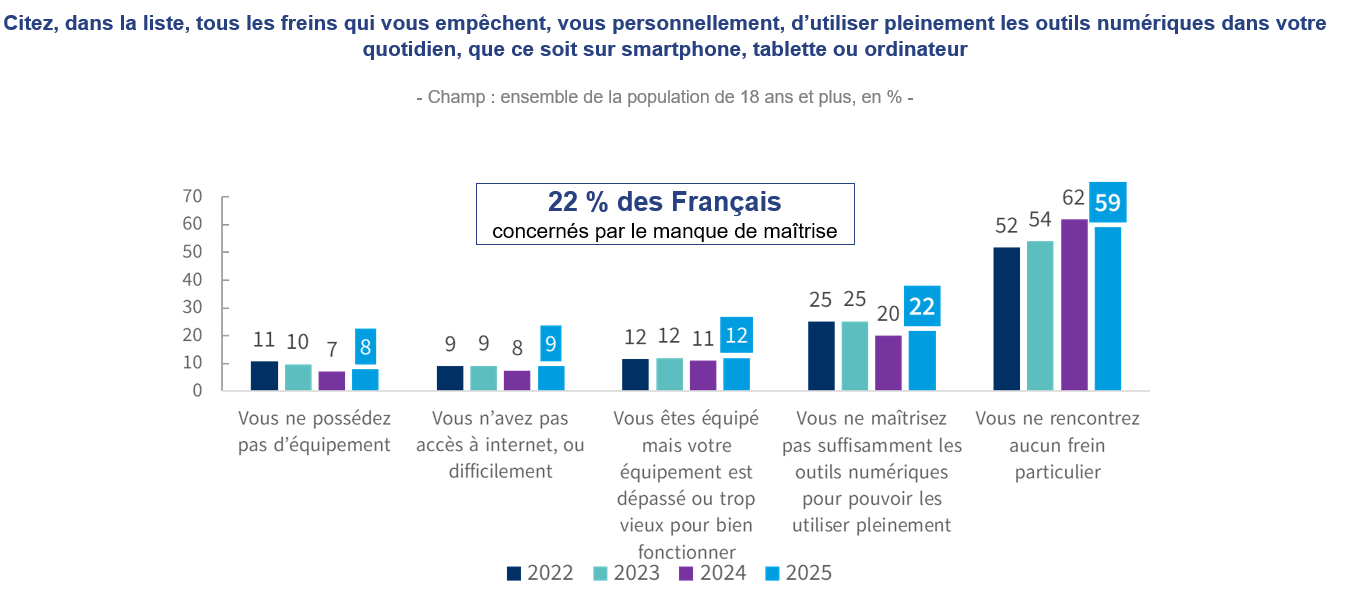
Four out of ten French people cite barriers to digital usage: first and foremost, a lack of proficiency with digital tools.
In 2025, 60% of French people believe that there are no obstacles to fully using digital tools in their daily lives (whether on smartphones, tablets, or computers). This proportion fluctuates significantly from year to year (from 55% in 2023 to 64% in 2024), but without any clear improvement in terms of people's perceived mastery of digital tools.
As a result, four out of ten French people still encounter obstacles that prevent them from using digital technology on a daily basis. The hierarchy of obstacles cited remains similar from one year to the next: 22% cite a lack of proficiency with the tools (+3 points in one year), 11% cite equipment that is too old to function properly, 8% cite a lack of equipment, and 8% cite difficulties accessing the internet.
Those with fewer qualifications particularly affected by difficulties
These obstacles primarily affect groups of the population with low levels of education. These groups are not necessarily older.
Access to and use of equipment, the ability to develop digital skills and identify tangible opportunities and benefits from digital use depend on economic or cultural capital. The work carried out by the ANCT on digital exclusion [1] highlights the structuring role of educational attainment in these situations involving digital practices. The report La société numérique française : définir et mesurer l’éloignement du numérique (The French digital society: defining and measuring digital exclusion) explains how cultural capital, of which educational attainment is one of the key determinants, conditions access to, and the diversity and complexity of, digital uses. People with few or no qualifications are more likely to have a limited repertoire of digital practices. This recent research, which shows a clear correlation between a low level of digital technology adoption and a low level of cultural capital among individuals, is consistent with the international academic literature on the subject, which places the level of education at the heart of digital inequality [2].
The report Narrowing the digital divide: Economic and social convergence in Europe’s digital transformation by the European Foundation for the Improvement of Living and Working Conditions (Eurofound) also notes, based on EU ICT surveys and the Digital Economy and Society Index, that digital exclusion correlates with social exclusion.
The acquisition of this digital social capital may still be linked to age, but again mainly because of the lower level of education among the older segments of the French population and their lack of familiarity with digital tools during their working lives. However, this generational interpretation is becoming less and less relevant in assessing digital exclusion, in favor of a social approach.
The lack of sufficient mastery of digital tools for their full and complete use on a daily basis is thus the primary obstacle highlighted, but also the only one specifically mentioned by older people. It is cited by 26% of 60-69 year olds and up to 35% of those aged 70 and over, alongside more generally retirees (32%) and people with no qualifications (29%) or few qualifications, at BEPC level (26%). This feeling of lacking the skills to use digital technology on a daily basis goes hand in hand with a reported lack of skills in all areas tested in this survey: 42% of people who say they do not consider themselves competent in using generative AI tools, office tools, digital platforms, or online administrative procedures believe that their lack of proficiency hinders their digital usage.
Other barriers to everyday digital use are more widespread across all age groups and are mainly linked to the respondent's socioeconomic background: The lack of equipment particularly affects those without qualifications (23%), manual workers (11%), alongside 18-24 year olds (11%) and those aged 70 and over (14%). Difficult access to the internet is more prevalent among those aged 70 and over (13%), but also among 18-24 year olds (19%) and 25-39 year olds (10%).
Mobile-only internet access is more common among younger and more vulnerable groups, which can result in "difficult" internet access. 13% of people who only connect to the internet via their smartphone point to difficulties in accessing the internet as a barrier to their use.
These analyses reveal that perceived difficulties with digital technology are not specific to any particular age group, as they are found at both ends of the spectrum, among both younger and older people. However, the sociocultural context remains a constant factor in these expressed barriers.
The results of a logistic regression analysis, known as "all other things being equal," confirm that educational attainment is a factor that explains the perceived difficulties in using digital tools. In other words, when age, income level, and place of residence are comparable, people without a degree are more likely to report barriers to digital use than those with a degree.
Références :
The French perception of digital technology in their daily lives is primarily influenced by the socio-cultural context.
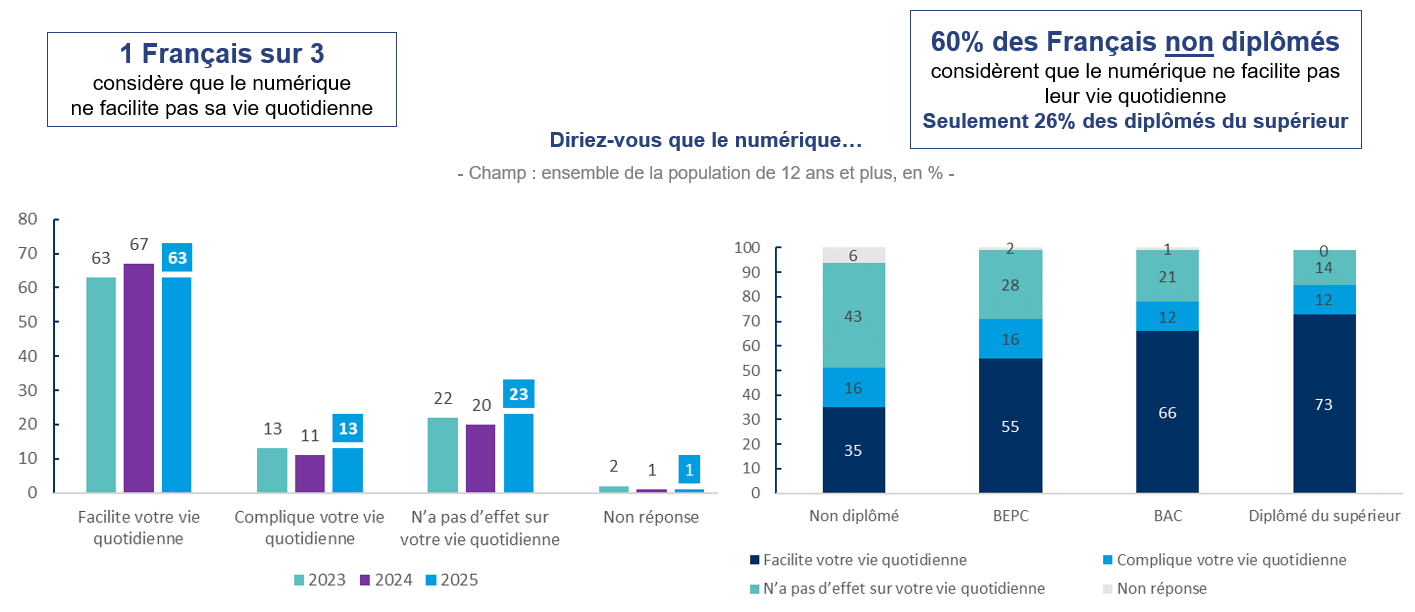
The motivation to use digital technology, even before access and usage conditions, appears to be a factor that encourages or hinders the adoption of digital tools. However, stability is also key in the perceptions of French people. More than one in ten French people (13%) consider that digital technology complicates their daily lives, and 23% believe that it has no effect. In other words, one in three French people believe that digital technology does not make their daily lives easier. Yet perceiving the concrete benefits of using digital technology is a powerful lever for the adoption of these technologies. This perception is shared by nearly two-thirds of the population (63%), a proportion that has remained stable since 2023.
Those most likely to view digital technology as a facilitator are executives (75%) and college graduates (73%), while those who are more critical tend to be low-income earners (16%), blue-collar workers (17%), and some young people (27% of 18-24 year olds). Many people without a degree believe that the internet has no impact on their daily lives (43%).
Référence :
These findings confirm lessons already identified in scientific literature, revealing an intertwining of social and digital inclusion difficulties, with populations at risk of social exclusion (those with lower educational attainment and less economic stability) also often at risk of digital exclusion.
Alongside social characteristics, attitudes towards digital technology also depend on a more general sense of competence. People who do not feel competent in using digital platforms (social media, online shopping, streaming sites, etc.) (22%) or office tools (17%), or even all of these at once (23%), are more likely to consider that digital technology complicates their daily lives (compared to 13% of the population as a whole).
For some, particularly young people, the perception of digital technology is not expressed in terms of inclusion or exclusion, but can reveal effects of overload or saturation: 20% of active users (daily comments and/or posts) of social networks believe that digital technology complicates their daily lives.
When asked to comment more specifically on the "impact" of digital technology on their personal and professional lives, French people express similar views, with a predominantly positive outlook that is nevertheless socially influenced. Up to 74% view the impact of digital technology on their personal lives positively, compared with 22% who view it negatively. Managers and professionals (86%) and high-income earners (81%) are among the most positive about the impact of digital technology on their personal lives, as are younger people (89% of 12-17 year olds). Manual workers (26%) and low-income earners (26%) are among the most negative.
Professionally, nearly two-thirds of French people who are employed or unemployed (76%) view the impact of digital technology on their professional lives positively, compared to 22% who view it negatively. Here again, executives and higher intellectual professions (87%), intermediate professions (80%), as well as higher education graduates (85%), members of the upper middle classes (80%), high-income earners (82%) and 25-39 year olds (79%) are much more positive in their assessment. Manual workers (34%), those without qualifications (40%), low-income earners (29%), 18-24 year olds (30%) and 60-69 year olds (30%) in employment are more likely than average to have a negative perception.
20% would like to have the choice of whether or not to use digital technology, while 18% want secure browsing.
The 36% of French people who responded that digital technology complicated or had no effect on their daily lives were asked to give their opinion on the conditions that would enable digital technology to make their daily lives easier.
Two main priorities emerge: 20% want to be able to choose whether or not to use digital tools and the internet, an option particularly favored by those aged 60-69 (29%) and the upper middle classes (27%); 18% prioritize secure online browsing, particularly those aged 40-59 (23%).
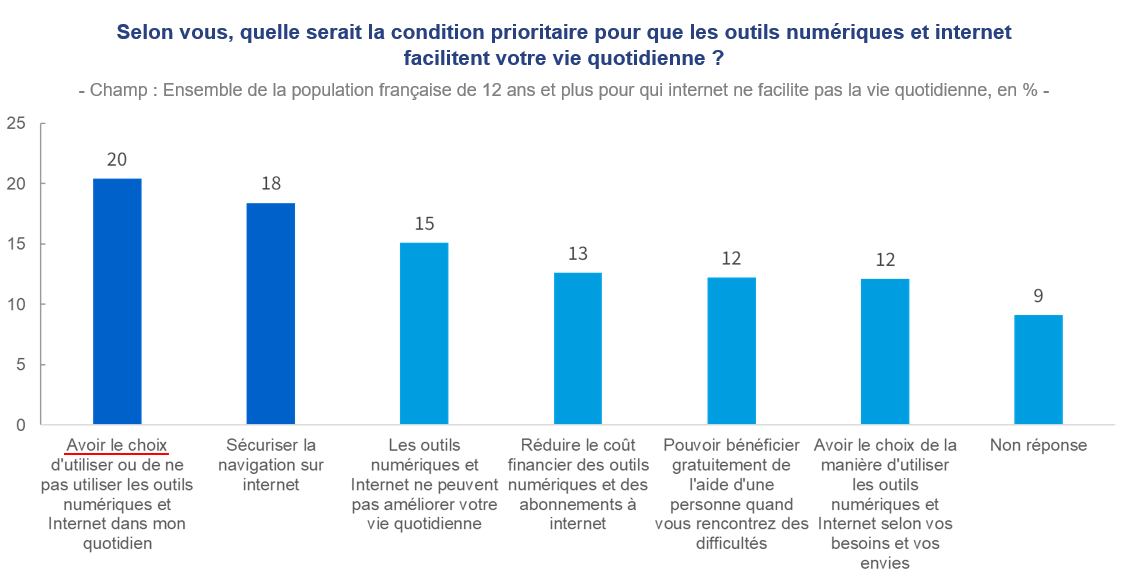
Other expectations, less widespread but still significant, concern freedom of use and the relationship with digital technology: on average, 12% want to be able to choose how they use digital tools according to their needs and desires. This proportion is significantly higher among 25–39-year-olds (20%) and among people who are very active on social media, i.e., who post or comment on a daily basis (20%).
Finally, 15% believe that digital tools cannot improve their daily lives, a perception that is more common among those without a degree (21%).
Nearly 6 out of 10 French people are digital caregivers.
Nearly six out of ten French people have already played a role as a digital helper (57%). This help is often focused on a single social network rather than being diversified: 42% of French people only help one category of people in their circle, while 15% help several. Help for family members is the most common (36%), followed by help for friends or neighbors (21%), then help for a colleague at work or school (11% of the population and 18% of people in employment or education), or other people in the professional sphere such as clients, users, or beneficiaries (9% of the population and 15% of people in employment). The large proportion of French people who help someone in their circle to use digital tools illustrates the need to support the population in adopting these technologies.
In France, 11% of the population aged 5 and over are family caregivers, meaning they provide regular informal assistance (emotional support, help with daily living, financial or material assistance) to people who have lost their independence, have a disability, or suffer from a chronic illness. These family caregivers are generally women (58%)[6].
In terms of digital technology, however, the caregivers surveyed in this barometer are more often men (61%). Men may feel they have greater legitimacy, even though men and women now report similar levels of use for historical digital applications. This gender effect on digital caregiving could be linked to the very design of digital spaces, which are more often initiated by men. In addition, women report greater exposure to inappropriate or problematic content on social media and greater difficulty in protecting themselves from it, particularly through reporting (see section 0 of this report): this exposure may reduce their comfort level in using digital tools and becoming digital caregivers.
Furthermore, the profile of informal caregivers is traditionally older[8], whereas digital caregivers tend to be younger (82% aged 18-24 and 77% aged 25-39) and have higher education qualifications (71%). These profiles are particularly overrepresented among people who provide digital assistance to more than one social network, with the exception of 18-24 year olds. These characteristics converge with those identified in the literature, as these are often people who are able to learn the solution to the problem themselves online before helping those around them[9]. Digital assistance is strongly linked to perceived skill level and the ability to acquire new skills: the more competent a person feels in multiple digital areas (AI, office automation, administration, platforms, etc.), the more likely they are to identify as a helper. Thus, 77% of people who feel competent in all of the digital areas offered are helpers.
Despite this feeling of digital comfort, 14% of people who say they help others with digital technology believe that digital technology complicates their daily lives. For those who provide digital assistance to their friends and family, the two factors that would make digital technology more useful in their daily lives are the ability to choose how to use digital tools and the internet according to their needs and desires (17%) and the possibility of reducing the financial cost of digital tools and internet subscriptions (16%).
1 in 2 French people have already helped a family member complete an administrative procedure online.
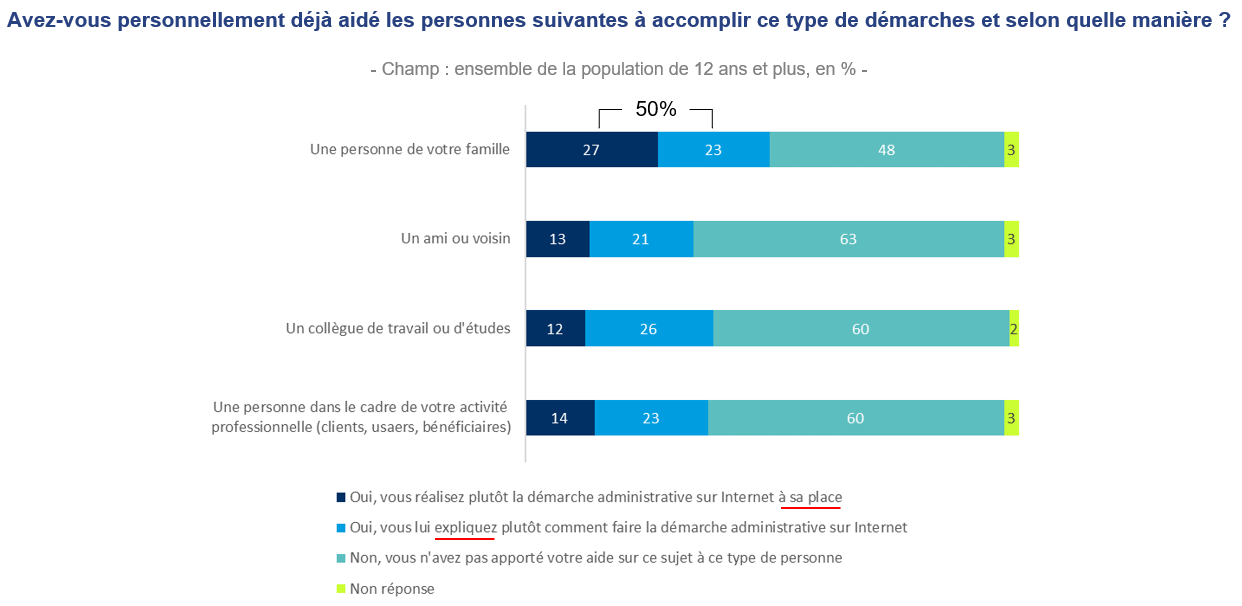
With the rise of online administrative procedures, a need for specific support has emerged (nearly one in two French people say they encounter difficulties when completing administrative procedures online[10]. 41% of French people say they provide specific help to their friends and family with e-government procedures. This proportion rises to 50% of French people when this assistance is specifically for a family member. This assistance is likely to lie at the intersection of digital support needs on the one hand and administrative needs on the other. In fact, people who say they provide more general assistance in the digital sphere and help several of their social networks (family, friends, colleagues, etc.) are even more likely to provide assistance with e-government (66%).
Références :
The profile of e-government helpers is therefore very similar to that of digital helpers in general, and feeling digitally competent also has an impact on helping loved ones with their online administrative procedures.
Assistance with online procedures can be provided, as can assistance with the use of digital tools in general, to one or more groups of relatives. However, the rule here is not targeted assistance but rather diversified assistance: 21% of French people only provide assistance with e-government to a single social network, while 33% do so to several. One in ten French people even help all of the networks described: family, friends or neighbors, work or study colleagues, and other people in their professional network (customers, users, beneficiaries).
The people most frequently helped remain family members. 50% of French people provide them with help in this area, 27% by completing administrative procedures online on behalf of a loved one, and 23% by explaining how to do so.
On the other hand, among colleagues, assistance more often takes the form of explanation (26%) than "doing it for them" (12%). In the broader professional context, too, support is more often provided through the transfer of know-how: 23% explain how to complete an administrative procedure online, compared to 14% who do it for the user. Outside the family sphere, this trend may be linked to the intimate and personal nature of certain administrative procedures. Indeed, providing assistance by completing a procedure on behalf of a user sometimes involves accessing financial or health data, or using usernames or passwords, which can cause reluctance when done outside the family sphere.
When encountering difficulties with e-government, human support is highly sought after.
The digitization of administrative procedures has led to a disintermediation between the administration and citizens: the latter, faced with a screen, find themselves in direct contact with the procedures and vocabulary specific to the administrative field. The previous edition of the Digital Barometer shows that this direct administrative relationship causes difficulties among the population, in particular the fear of making mistakes (18%) and a lack of understanding of what is required to complete administrative procedures (13%), ahead of the feeling of a lack of digital skills (11%). These difficulties in completing administrative procedures online highlight the need for support for the population. This edition of the Digital Barometer sheds light on the type of assistance that French people would prefer to receive when encountering e-administrative difficulties.
Overall, French people prefer to seek human assistance when they encounter difficulties completing administrative procedures online[11].
Référence :
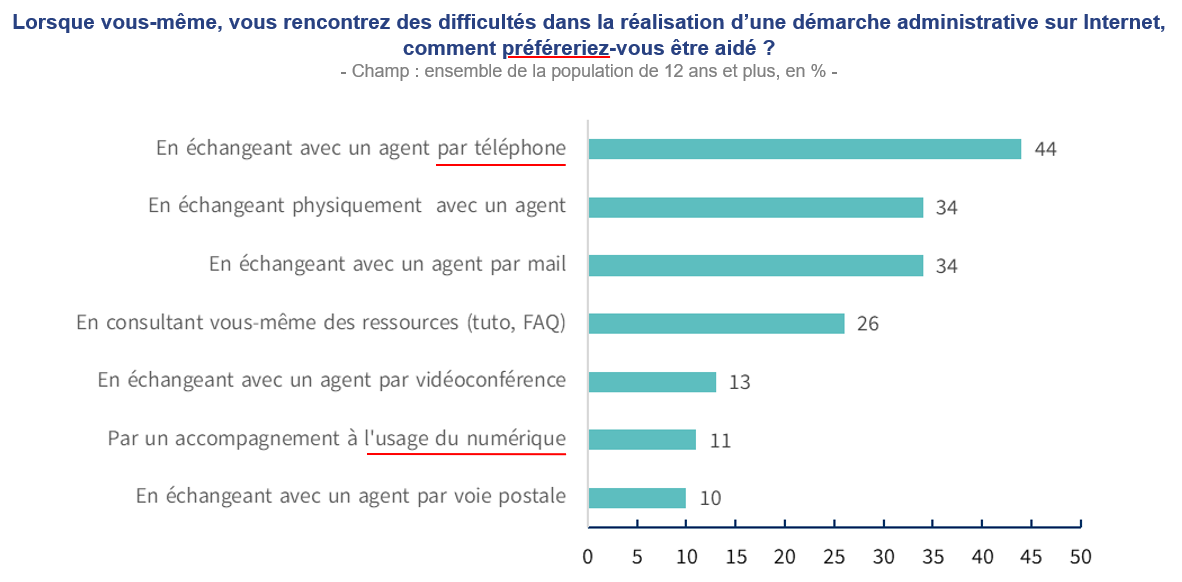
Telephone communication with an administrative agent (44%) is the preferred channel of administrative mediation among those offered. Managers (52%), those with the highest level of education (50%), high-income earners (49%), and women (47%) are the most likely to prefer this method of contact.
Secondly, 34% of French people surveyed prefer face-to-face assistance when they encounter difficulties. Younger people are the least likely to prefer face-to-face assistance (only 24% of 18-24 year olds mention this). This finding is relatively consistent across the population, regardless of gender, level of education, or income. This preference for human contact is well established among the population and was already evident in the early 2010s[13]An equal 34% of French people prefer to contact an administrative agent via email. Popular among executives (42%) and 40-59 year olds (38%), contact via email is less appealing to those without a degree (20%) or those with the lowest incomes (30%).
Next, we find the use of tutorials (26%) or videoconferencing (13%). These communication channels are more appealing to young people, college graduates, and executives, who are more comfortable with digital technology.
Postal mail, cited by 10% of respondents, is particularly appreciated by people who do not feel competent in e-administration (18% for those who say they are not at all competent). Younger people (15% of 18-24 year olds) also show some interest in postal mail.
Interestingly, providing specific support for using the internet and digital tools does not seem to address the population's wishes, and therefore their difficulties, in carrying out such procedures (cited by only 11% of respondents). This suggests that these difficulties are less related to a lack of digital skills than to a lack of administrative skills (e.g., translating one's socio-professional situation into an administrative category). However, acquiring digital skills could facilitate access to online administrative procedures upstream (learning how to use digital equipment, navigating the Internet, etc.).
Seeking human contact in the event of difficulties also appears to be more effective than other forms of mediation: according to the report on access to public services[14], 72% of follow-ups made in person at a service desk were effective, as were 67% of those made by telephone, compared with only 55% of follow-ups made by mail.
Références :
Sources
7. See in particular Collet, I. (2019), Les oubliées du numérique (The forgotten women of digital technology). Paris: Le Passeur éditeur, or statistical data on the profile of designers of digital spaces in France (Dares (2019), Data scientists, community managers...and computer scientists: what are the digital professions? and in Europe European Institute for Gender Equality (2020), Gender Equality Index 2020: Digitalisation and the future of work. See also the work carried out by ANCT, with CREAD and CREDOC on digital exclusion, in particular: ANCT, Crédoc, Université Rennes 2 CREAD-M@rsouin (2025), La société numérique française : comprendre les freins psychosociaux à l’usage du numérique (The French digital society: understanding the psychosocial barriers to digital use).
10. See in particular Arcep, Arcom, CGE, ANCT (2025), Baromètre du numérique, 2025 edition (fieldwork 2024), and Défenseur des droits (2025), Enquête sur l’accès aux droits sur les relations des usagers avec les services publics : que retenir ? Accessed on November 25, 2025.
11. See the methodological note in the full report for precautions regarding the use of this data.